

Resources for AI Governance
How to Use NIST AI RMF as an Operating Framework
Why a voluntary framework still matters, and how to use Govern, Map, Measure, and Manage as a practical operating model
Official NIST guidance
“The AI Risk Management Framework (AI RMF) is intended for voluntary use and to improve the ability to incorporate trustworthiness considerations into the design, development, use, and evaluation of AI products, services, and systems.”
Source: NIST AI Resource Center, AI Risk Management Framework.
The short version
The NIST AI Risk Management Framework is voluntary, but that does not make it
irrelevant. Many businesses do not need another abstract law summary. They need a
way to organise AI governance work. The AI RMF gives them one. It is best read as an
operating framework, not just a policy document.
NIST says the framework is intended to improve the ability to incorporate
trustworthiness considerations into the design, development, use, and evaluation of
AI products, services, and systems. That combination of voluntary guidance and
operational structure is why the framework is useful. It gives companies a common
language for AI risk without pretending every use case is identical.
Why the framework matters
The AI RMF matters because many organisations are stuck between two weak options.
One is to do nothing until regulation forces them. The other is to create a pile of
abstract principles that nobody can run day to day. The framework offers a more
practical middle path. It turns governance into repeatable work rather than a set of
slogans.
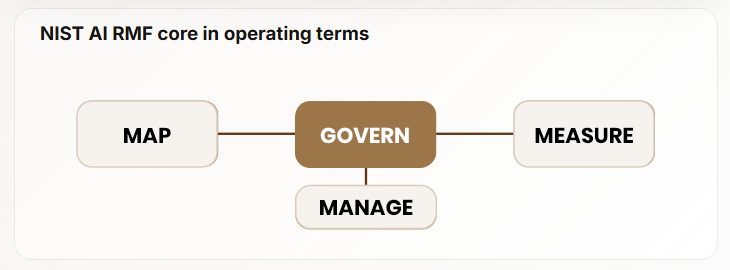
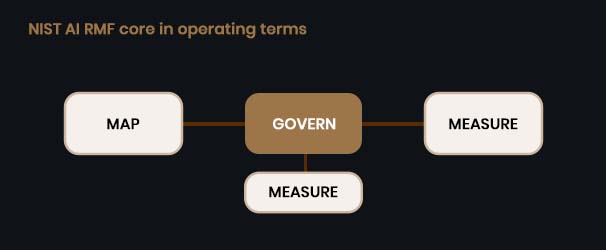
The current AI RMF Core is built around four functions: Govern, Map, Measure, and
Manage. Govern is the cross-cutting function because it applies across the lifecycle
and connects AI risk to organisational policy, culture, accountability, and
oversight. Map is about context and intended use. Measure is about assessing risk,
performance, and trustworthiness. Manage is about acting on what has been learned.
The supporting Playbook then gives suggested actions for outcomes across those
functions, while making clear that it is not a checklist to be followed mechanically.
How to use it operationally
The most useful way to apply the framework is not to ask whether your company is
“compliant with NIST.” That is the wrong question because the framework is voluntary
guidance, not a certification law. The better question is whether it helps you
structure governance in a way that management teams and auditors can actually use.
In many cases, it does.
Govern maps well to internal roles, policies, approval paths, escalation routes, and
leadership oversight. Map works well for system inventory and use-case framing.
Measure can support evaluation, testing, controls, and evidence. Manage works as the
action layer that connects risks to concrete decisions. In that sense, the AI RMF is
less a legal shield than an operating backbone.
Practical takeaway. The AI RMF is most powerful when it becomes part of how a company runs AI governance, not when it sits as a PDF in a policy folder.
Where it fits next to regulation
The framework does not replace regulation. It complements it. A company facing the
EU AI Act, customer diligence, procurement questions, or internal audit still needs
to understand legal obligations. But legal obligations alone rarely tell an
organisation how to structure ongoing work. That is where the AI RMF helps. It gives
a practical governance shape to activities that otherwise stay fragmented.
That is also why the framework is useful outside the United States. Even though it
was developed by NIST, its governance logic travels well. Businesses can use it as a
common operating model while adapting legal detail for the EU, UK, sector rules, or
customer expectations.
In brief
- • The framework is voluntary, but highly usable in practice.
- • Its value is operational structure, not legal substitution.
- • Govern, Map, Measure, and Manage translate well into day-to-day governance.
Why companies should care
Because most companies do not fail on AI governance for lack of principles. They fail because they do not have an operating model that turns principles into repeatable work.